

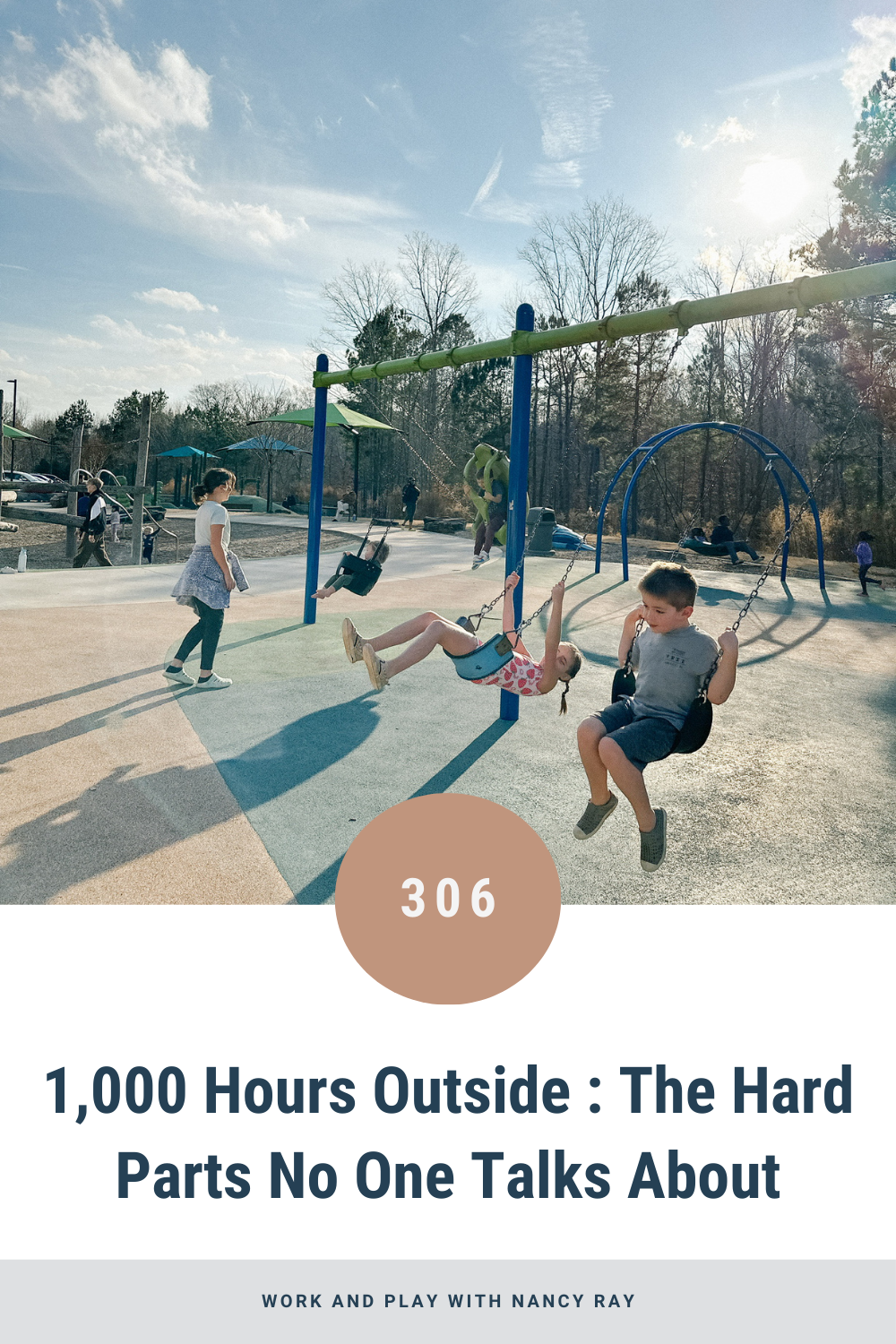
306 - 1,000 Hours Outside : The Hard Parts No One Talks About
Affiliate links have been used in this post! I do receive a commission when you choose to purchase through these links, and that helps me keep this podcast up and running—I truly appreciate when you choose to use them!
Resources from this episode:
Show Notes:
Today I want to talk about something that I have been absolutely loving with my kids this year. It’s the 1,000 hours outside challenge. I want to get into the hard parts, the real parts, and why I truly believe your nervous system is begging you to step outside.
For the full episode, hit play above or read through below.
Okay, I’m so excited about this month on the podcast. We are in our authority and abundance series and today, we’re starting in the backyard. Okay, I want to start by sharing where this came from, what I’m thinking, and something that has just genuinely surprised me at how much I’m loving it already in the winter, and that is this 1,000 Hours Outside challenge.
Now, I knew getting outside was good for you. I knew it in my head. I love being outside. I was a runner for years. I still love to run, workout outside. I love being outside. But I did not fully understand just how much my body needed it on a daily basis until I (I should say we), as a family, committed to this 1,000 Hours Outside challenge with my kids.
Okay, so if you haven’t heard of it, the 1,000 Hours Outside challenge is exactly what it sounds like. The goal is to get your kids outside for 1,000 hours in one year. You have a tracker. Like, we’re filling in the little bubbles every time we spend one hour, we get to cross off, you know, fill in another bubble and it’s really fun to be able to track it that way. But breaking it down, what that looks like is that you are outside two to three hours a day on average throughout the year.
Before you panic and say, “Nancy, I do not have that kind of time”, I want to gently push back on that because I said the same thing. It doesn’t always look like two to three hours every single day. Every week, every day looks different. The day that I’m recording this podcast episode, I have not even spent an hour outside. It ebbs and flows, but you can make it work with your life. I want to push back because I said the same thing. I really believed I could never do this. I’ve known about this challenge for years. This is the first year I’m actually doing it and we’re actually tracking it. Let me just say, wow, like holy cow. It’s changing my life. It’s changing our kids’ lives, our family’s life. It’s amazing.
So this is a movement that was started by Ginny Yurich and it’s rooted in this idea that kids today spend far less time outside than previous generations. It’s not just about nature. It’s about letting your kids have the freedom to play and imagine. It’s about that unstructured time. We’re not planning things for them. It’s about slowing down, having that sensory input, and just being present. It’s about getting your kids out of the house, off of screens. Even for us, it’s like out of their habits of just reading in their room, which is a wonderful habit, or just playing with their toys in their playroom. It’s about getting them into new environments and getting that fresh air and getting them in contact with the soil and nature and God’s beautiful world.
So we’re doing it. We’re trying to spend a thousand hours outside this year and it’s been so life-giving. Let me just say this. I don’t know that we’re going to hit the mark. Like, I’m already feeling behind. We’re coming up here, you know, the end of where I guess we’re approaching spring. We’re finishing out winter and I’m starting to feel behind. But what I love that Ginny says often on her Instagram page or podcast… She always says, “So what if you try for a thousand hours outside and miss the mark? What happens then? You only benefit from this challenge. Would you have spent more time outside this year than if you didn’t try for it?” The answer is a resounding yes. Like, we’re already spending so much more time outside this year than we would have if we didn’t have the challenge. So even if we get to 800 hours or 900 hours or 600 hours, like, we will be spending more time outside because we’re tracking it and trying for it than if we don’t try.
I’m hoping we hit a thousand. Hello, enneagram 3 Nancy really wants to achieve the thousand-hour mark, but I am holding it loosely, knowing if we don’t, we will have still benefited so much from this challenge. So we’re trying to do it. This is not just for my kids. This is for me. This is truly something that I set out to do for my kids. But I’m realizing, holy cow, I am benefiting so much from being outside with my kids more.
Now, I’m not going to pretend like it’s easy. It has been a shift for us as a family. It has not been easy every day. It’s not like we have this perfect rhythm that we’ve created. Like I said, every day is different. What I want to do today is I want to be honest with you about the hard parts of it because I think that’s what you need to hear when you’re considering a challenge like this. But I also want to share with you the incredible benefits that we’ve already experienced from it if you’re considering it.
Okay, the first hard part I want to mention is the weather. Depending on where you live, the weather is going to be a challenge. No matter where you are, but there are some of you listening who are going to have much harsher winters than what we have here in North Carolina. There will be some of you listening who have much harsher summers. Every climate is different. You kind of have to prepare and plan accordingly. There are some days where it is just freezing cold, raining, where there’s ice all over the ground. That has been our reality this winter. The last thing I want to do is bundle up five kids and take them outside. So there are days where I’m just like, nope, we are not. We are not doing that today and that’s okay.
Then there are other days where the weather is kind of crummy, and I’m like, this is not ideal, but it’s not the worst thing ever. Let’s put on our coats and let’s go outside for like 30 minutes. Like, let’s just get 30 minutes of fresh air today. Some days the weather is fine and my kids just do not want to go. Like, they think that I’m torturing them by getting them outside, and they’re like, no, you know, they’re crying. They just don’t want to get out the door. That’s emotionally hard. It’s just challenging to just come up against this resistance.
Some days I don’t want to go. Like, sometimes I’m like, it would be so much easier for me to just stay in my house and finish this laundry and finish cleaning the kitchen and plan out, do my grocery order, let it be delivered, like everything. I just need to be in my home and I don’t want to go outside. I don’t want to make that effort and that’s real.
Then there’s the planning aspect of it. I’ve learned that my kids really do well outside at a park. Like, if they’re in a different environment than at home and there’s not even an option for them to come inside, they are happy as can be. Love it. Love the park. Of course, there’s fun things for kids to do at a park. So we’ve been really incorporating hitting a park for an hour on the way home from school or from wherever, like grocery shopping or you fill in the blanks, errands. Like, we’ll just try to incorporate an hour at the park too.
But the planning aspect, like you can’t ignore that you do have to kind of plan for this. It’s like if that’s going to be part of your life, you have to plan for it. When your life is full, adding something like an hour at the park seems easy enough, but it does kind of mess with my normal rhythms. I’m adding in these hours at a park and that cuts down on dinner prep or that cuts down on my laundry folding. I’ve realized I’m needing to adjust my household work differently.
So it comes with adjustment. It comes with hard. It comes with resistance. But here’s what I’ve learned. You have to plan for it like it matters because it does. You can’t just hope to go outside sometimes. For my kids, they’d be like, yeah, let’s go outside and like 30 minutes later, they’re done. They’re like, okay, mom, we were outside. We’re done. So you have to plan for it. Say, no, we are going to plan for two hours outside. How are we going to do that today? Where are we going to be? If we’re home, what does that look like? Do you want to get a lawn chair and take a book in the driveway, which my kids love to do. Do you want to go play on the zipline? Do you want to run around the house five times? Do you want to do races in the back? Like, what is that? Trying to give them some creativity just to get them going and then they just kind of launch themselves. But also, when they know they’re supposed to be outside for two hours, I feel like they get more creative because they’re like, I have to be. Like, I have to figure out something to do.
But you have to build it into your schedule. So we have specific times of the day and specifically the week, because of the cadence of our week with the university model school, that we plan to be outside for one to two hours. We plan it in, just like meals, just like naps, just like school. I treat it as this thing that we are going to do today. Every single day I aim for an hour. On the prettier days or the days where we just have more time, I will try to sneak in another two, maybe three hours.
So it comes with resistance. You have to plan it. But I want to kind of start talking about the benefits of spending time outside. Here’s what I’ve noticed in my own body. This has blown my mind. When I’m outside with the kids, I can tell that my mind feels clearer and my stress levels are automatically lowered. Like, just as a blanket statement, when I’m outside.
Sometimes there’s been times where it has been stressful getting the kids out the door or I’m stopping by a park and my mental list is so long. I’m like, what am I doing? Why am I doing this? It’s stressful for about the first 10 minutes, but I tell you what, about 15 minutes in, I am not as stressed anymore. It’s like my stress levels just plummet when I’m outside. I don’t know how else to say it. Something physically shifts in my body, like in my physical body, when I’m outside. The cortisol drops, my shoulders come down from my ears, I breathe differently. I truly think so much more clearly about what I have to get done. My best ideas come when I’m outside.
Here’s the thing : science actually backs this up. Spending time in nature has been shown to lower cortisol, like to actually lower stress, to reduce anxiety, to improve your mood, and boost creativity. But I don’t really need a study to tell me that, even though it does line up with science because I am feeling it every single time I go outside. I hope that that is the encouragement that you need to try this.
Here’s what I’ve noticed in my kids. So that’s what I notice in me. What I notice in my kids : they’re different outside. Sure, they whine and complain at first. That’s normal. They don’t love a new routine. They don’t love adjusting. They don’t love to be outside when it’s my idea. They love it when it’s their idea. So there’s some resistance at first, but once they accept we are outside and we will be outside for a little while, once they accept that and they get into the groove of being outside, they are different kids, like in the best way.
When we’ve been cooped up, there’s a lot of togetherness in our home. There can be some tension, some fighting, some I need some space. There is just like restlessness when we’re inside for too long and we get outside, that clears up. It’s crazy. Something shifts for them. They play together better. They’re more imaginative. They’re more settled and the behavior that kind of just drives me crazy inside, where I’m constantly like trying to control their behavior or correct them or tell them what to do or play nicer with your brother or sister, all of that just kind of dissolves when we’re outside.
I know this sounds crazy, but it is. I actually, I know this might sound crazy to some. I actually think that probably most of you who are listening are like nodding your heads, like that’s true. Like that is true. Because something shifts when our kids are outside and they’re in that fresh air.
I don’t think it's a coincidence, though. Like, if you think about it, and this is a thought that has been in my brain all year long as I’m outside. God designed this big, beautiful world for us to actually be in and we have built these amazing homes and museums and libraries and play places that are great and amazing, but we are shielding ourselves from the sky and from the sun and from the fresh air and from the oxygen that the trees are making and from the ground underneath our feet. Our bodies are literally longing for those things and we don’t know it until we get outside. There’s something deeply restorative about being outside because our bodies were made to be in God’s creation.
I mean, think about it. He put us in a garden first; not in a building.That’s a beautiful thought. So if we can get outside and forget just being inside and forget about our schedules for a moment, forget about all of our mental to-do lists and overwhelm, when we get outside we can take this breath of literal fresh air and clear our minds and our bodies, I feel like, just relax. We are where God made us to be, like in nature, in His creation.
So here’s how this practically works for us as a family. I just skim over our week and look at what we have going on that week and I identify the windows of outside time. When can we realistically get outside? Then I put it in my plan. I treat it like an appointment. I also love to look at the things we have going on and ask myself, can we do that thing outside? Practice piano? No, the piano is in our living room, you know. Go to school on campus? No, they’re at school two days a week. They have to be in school. They do get recess and outside time at school. But I’m looking at our homeschool days and I used to always do all their homeschool inside. Now I am trying to figure out how to do much of our homeschool outside, setting up tables, getting in chairs, sending them outside for assignments so that we can double up and do that outside.
So after I look for those windows and kind of plan it in my calendar, then I lower the bar. Outside time, it’s not extravagant. It’s not always at a park. It’s not always a beautiful hike or, you know, planned play dates that are only outside or whatever. It literally is like, kids, go outside in the driveway. Go play in the driveway. Go play in the yard. Go to the backyard while I drink my coffee. It’s like, hey guys, go walk to the stop sign and back or go walk around the house five times or figure something out, you know? It can be eating lunch in the driveway, like on a blanket or on a beach towel. All of that counts. All of it counts.
So I look at my week. I look for the windows. I plan it in. I lower the bar. I keep it very simple. I just try to get some sort of outside time in every day that fits and flows with our schedule. Whatever makes it easiest on me is my “yes” for the outside time.
Then third, I anchor it to something that we already do. So one thing that I’ve been trying to do is when I pick them up from school, we head straight to a park. We just spend 30 minutes to an hour outside at a park before dinner. Or on days where it’s homeschool or I’m hoping much more in the summertime, like first thing in the morning outside. It’s outside time. So when it’s attached to an existing habit, it sticks. Every Sabbath that has pretty weather, we are on a hike as a family spending two to three hours outside. So those things that are already kind of solidified in our schedules, we know, okay, we’re attaching outside time to that to hit this goal.
But here’s what I really want to speak to. I think that for a lot of us, especially as moms, we are running on empty. We hear the term “mental load” like 1,000 times because it’s real and because our brains, what do they say? Women’s brains are like spaghetti. Men’s brains are like waffles. Like, they can compartmentalize stuff and we have spaghetti brains. It’s like everything’s crossed over and intertwined and we think about one thing and we think about the next and we’re thinking about our household, and we carry a lot. The mental load is real. It’s a lot. We are looking for ways to make our lives easier, to make our lives more productive. We’re looking for strategies to simplify the seasons we’re in. I am. I am hungry for those things all the time and I’m constantly trying to improve myself and my life. But I want to offer this as not a solution to like fix all those things, but it’s just something that you can factor into your already life, like you can integrate it into the life you’re already living, that will benefit you so much, bring your stress levels down, and help you have the clarity of thought and simplify your life in a lot of ways.
It almost feels too simple, but it truly is just to go outside. Just go outside. Mom, like you, mom, with your kids, go outside. Not because you have to hit a thousand hours. Not for your kids because they need the developmental benefits, although all of that is true. They do. But because God made the beautiful world He did for you too. He invited you and me into it too. Sometimes the most spiritual thing that you can do is to step away from cleaning the kitchen or folding the laundry or ordering the groceries, even though all those things are good and we have to do them, or creating the next piece of content or work or whatever it is that you’re working on. Sometimes the most spiritual thing and the most holy thing you can do is to just stand in the grass and take a deep breath of fresh air.
I have found more clarity outside than I have in almost any other rhythm in my life this year. If you’re feeling overwhelmed or anxious or tired, just go outside first. We have this like 30-minute minimum because we’ll save that 30 minutes and roll it over into the next day. If we do 30 minutes and 30 minutes, we still count it towards an hour. We’re tracking it. Just try it. Don’t even try 30 minutes. Just try 10, like 10 or 15 minutes outside. See what it does for your nervous system. See how it makes you feel. I think it will surprise you in the best way.
So before I close out this episode, I just want to ask, is this something you do? Is it something that you do regularly for your kids, but also for you? If it’s not, and you want to try it and you have a friend that might be interested in doing this with you, another mom or friend, whoever, that feels maybe burnout or like you both love being outside but you feel busy, why don’t you just share this episode with them? Forward it to them. Sometimes the most generous thing that we can do is just invite someone else into it with us. That’s kind of how this started for me is, like I said, I followed Ginny Yurich for a long time online and her podcast, but I’ve never actually committed to doing it. This year I printed off the freebie that she has online. So you can go and print off these amazing 1000 Hours Outside trackers from her website. I’ll leave the link for that in the show notes.
I saw another friend of mine, Valerie, who is online. She has four kids, and their family really prioritizes outside time. Right after I printed my tracker, she posted, “Look what we’re doing this year! 1000 Hours Outside.” That was like all the boost that I needed to say, “Look, another mom is doing this. Let’s go. Like I can totally do this.” Valerie, I don’t even think I told you that, but hopefully you’ll get this episode and you’ll know that you’re a big reason why I feel like we can do this. I’m believing that we can do this this year.
A couple of practical things that I’m going to close this episode with. I think it’s good to kind of figure out what boundaries work for you and your family. So a couple of rules that we’ve set for ourselves is it only counts if four of our five kids are outside at the same time. I told that to someone this week, and they were like, oh, whoa, really? I was like, yeah, for us, what would happen is two of our kids would spend most of their time outside and the other three would be inside, and they wouldn’t get the benefits. But we do have a baby at home who naps and takes long naps during the day. So I didn’t feel like it was fair to do like five out of five kids because she could really detract from the progress. So four out of five kids have to be outside.
There has to be nature below us and nature above us. Nature below, nature above, or one of each. No, I’ve kind of said like nature below, nature above. I’m like thinking this through now as I’m talking it out. I’m like, does the driveway count? I’m like, yeah, the sky is above you. That counts, even though it’s not nature under their feet. But you know what I mean. For us, our screened-in porch does not count because it’s like there’s a roof and then there’s a couch under you and there’s screens all around you. You’re not getting the benefits of being outside. So these are just rules that you might want to just think through. What is it like for your family? What counts for you? What’s the most beneficial thing for your family?
Then we have a color-coding system, which is so helpful in eliminating fighting over coloring in the little bubbles on the chart. Each kid has their own highlighter color and we just rotate like green, blue, pink, purple, green, blue, pink, purple, green, blue, pink, purple. So there’s never a question of like, is it my turn to fill in the bubbler? I’ve pinned the chart up. We got it printed big at Staples and I taped it up in our kitchen really big at a level where all the kids could reach it. Yes, we have five kids, but the baby’s not going to be coloring in her bubbles, which is why I named four colors.
Anyway, those are just practical things that have helped us clarify what it looks like and what works for us. I really just encourage you to try it. Maybe you feel like it’s too late this year. Try it next year. Or maybe you just download one of their 100-hour outside trackers and see how many of those you can do this year. Either way, your nervous system will thank you. Get outside and enjoy God’s beautiful creation. It has been one of the most surprising sources of joy and restoration in my life thus far this year. So I hope it gives you the same thing. I’d love to hear what you think. Come find me on Instagram @nancyray and tell me how it’s going.
Alright, thanks for listening to episode 306 of Work and Play with Nancy Ray. Everything I’ve mentioned today can be found in the show notes at nancyray.com/podcast/306 and you can find me at nancyray.com or follow me at @nancyray on Instagram.
I’m going to close with words from Richard Louv, author of Last Child in the Woods, who wrote,
“The time in nature is not leisure time. It’s an essential investment in our children’s health and in our own.”
Thanks for listening and I can’t wait to catch you next week in this new series, Abundance and Authority. I’ll see you then.

Quisque iaculis facilisis lacinia. Mauris euismod pellentesque tellus sit amet mollis.